
Lectio praecursoria (in ENGLISH)
Lectio praecursoria (introductory lecture for the doctoral defense), University of Eastern Finland, October 30, 2026
“Power from the Root.” Ethnographic Research on the Meanings and Reframing of shamanism in Finland south of Sámiland
Helena Karhu
Esteemed Custos, esteemed Opponent, esteemed audience.
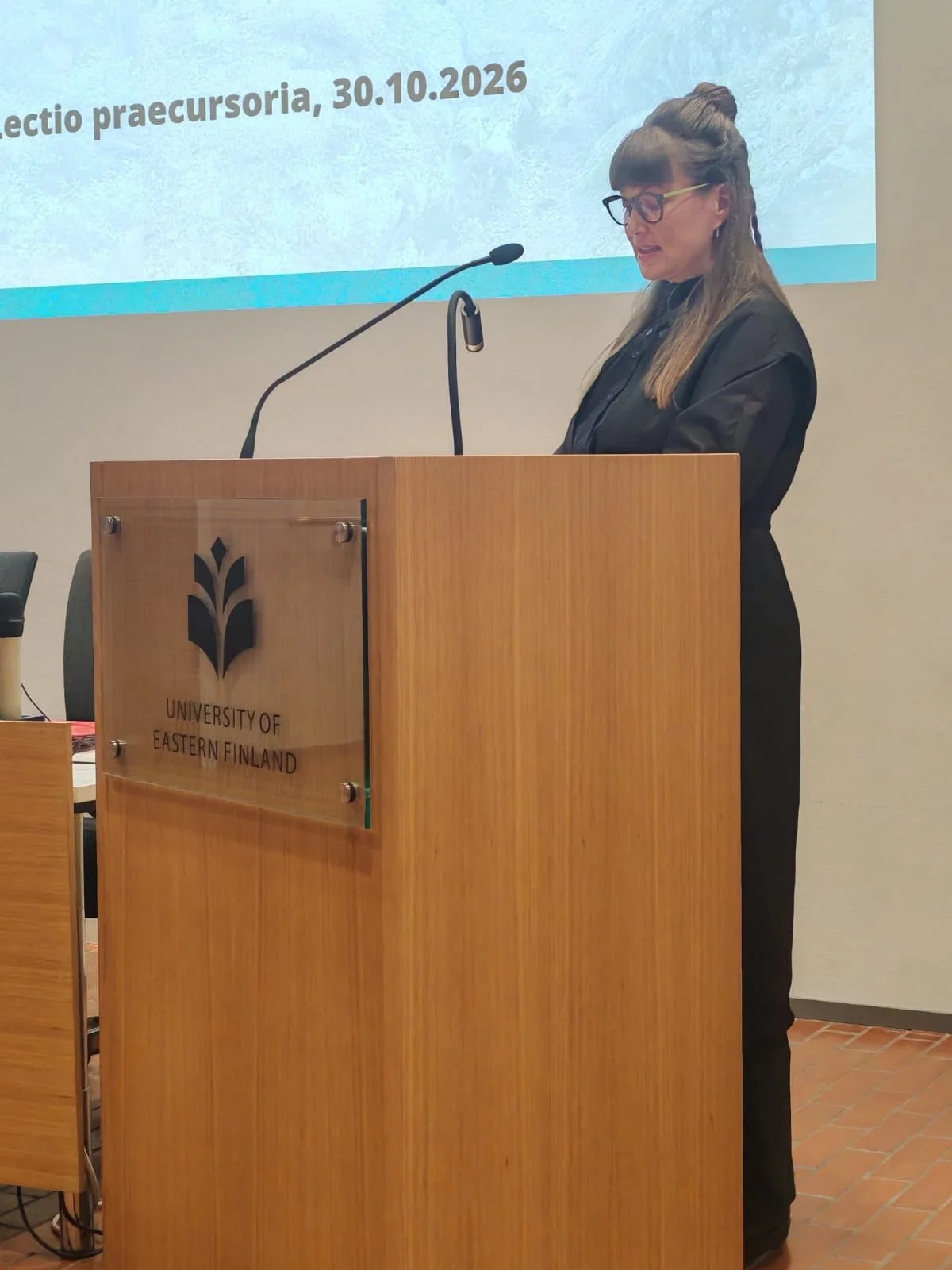
Photography: Terhi Hopponen
I begin by addressing the title of my doctoral dissertation: “Power from Beneath the Root!” (in Finnish “Juuren alta voiman!) This is an incantation for becoming a *tietäjä* (a traditional wisdom keeper)—recorded in the *Suomen kansan vanhat runot* (Ancient Poems of the Finnish People; SKVR, IX4, 2)—which was documented by Kaarle Krohn in 1885. Eepram Hakulinen, who was 24 years old at the time, recounted words he had heard from a timber foreman; the purpose of these words was to perform a spell—a method for “how one might acquire power for oneself.”
This incantation symbolizes the content of the dissertation at hand, which focuses on examining the forms of shamanism as they exist today—where the primal force of the shamanic tradition is rooted in a millennia-old, relational connection to nature, ancestors, and heritage.
In this study, that primal force manifests as a continuum linked to nature and intergenerational culture—a continuum that holds potential value for us in the present day, as a multispecies northern community. The magic incantations, for their part, serve as a reminder of this continuum. Relationality signifies the experience and knowledge that all of nature exists as an interconnected, non-dual interaction, a holistic unity. As the late shaman-artist Johannes Setälä (2018) wisely remarked:
“Nothing exists outside of everything.”
Stemming from this understanding, relational values pertain to multispecies existence and the extension of care toward the entire world.
The central question of my research is: What kinds of individual and communal meanings—and transformations—emerge through a shamanic lifeworld in the region south of Sápmi (the Sámi homeland) in present-day Finland?
This question is compelling because we currently live in an era of polycrisis, defined by climate change and military conflicts. On a collective level, these phenomena reveal that humanity is out of balance—with itself, with one another, with nature, and with the world at large. Yet, from a shamanic perspective—held by those who maintain a profound spiritual connection to nature—balance remains a possibility. I draw this interpretation from, among other sources, the interviews I conducted during my research—which I will discuss further shortly.
Shamanism is considered the oldest form of spiritual culture—a healing tradition—that has existed within the territory of present-day Finland ever since this northern land was first inhabited following the Ice Age. Shamanism has evolved over millennia—transforming into the tradition of the *tietäjä* (wise one/seer) and, subsequently, into the various contemporary forms of shamanism and *tietäjä*-like practices. It is also considered the oldest spiritual and healing practice of all humanity, varying according to location and specific context.
A shamanic practitioner views the world from an animistic perspective; they sense the life energies of various natural beings and show respect for the entirety of nature—both visible and invisible—of which they are a part. A relationship with nature is maintained through magical connections, rituals, and ceremonies, which are ideally rooted in the principles of reciprocity, care, and balance. Furthermore, this practice involves the central role of natural elements, the observance of lunar and seasonal cycles, and the influence of sacred natural sites. As I discuss in the third article—referencing sustainability researcher Pasi Heikkurinen’s (2024) compelling concept of the "core of nature"—shamanism can be understood as a way of living from within this core: a state in which we are nature ourselves and engage in reciprocal relationships with the rest of the natural world. Religious studies scholar Juha Pentikäinen (1996) identifies several key features of shamanism, including ecstatic techniques, a conception of the soul as having a multi-part structure, a three-tiered worldview, the notion of a shaman’s helping spirits, and specific shamanic objects—such as the drums discussed in this study.
In this doctoral dissertation, I have sought to gain an ethnographic understanding of shamanism as it manifests in Finland—specifically in the regions south of Sápmi (the Sámi homeland)—exploring its meanings and its capacity for change.
As there is currently very little research on contemporary shamanism in Finland, my study offers a new perspective on the subject within my own cultural context. Through this research, I aim to provide an alternative to viewpoints that suggest:
a.) That the most authentic forms of shamanism existed only in the distant past and that it is no longer a living tradition. In such accounts—often found in museum or exhibition texts—shamanism is described in the past tense, effectively rendering contemporary shamanic practitioners invisible.
or
b.) That the shamanism practiced today is merely a form of "neo-shamanism" or "neo-spirituality" (New Age)—an individualistic phenomenon detached from, or even a fragmented remnant of, the original tradition—in which the shaman is simply reconstructing the past or inventing entirely new rituals. In this context, contemporary shamanism is regarded as a form of hedonistic lifestyle. In such accounts, the spiritual reality experienced by contemporary shamanic practitioners is overlooked, and shamanism—along with its continuity through the ages, embodied in our bones and muscles—is trivialized.
As an insider who experiences shamanism firsthand, I do not find these perspectives to be accurate, a conclusion based on my own experiences and conversations with many others who also engage with shamanism. I discussed this, among others, with my collaborative research partner, the *tietäjä-noita* (shaman-witch) Miika Vanhapiha. Consequently, in this study, I wish to introduce a perspective I term "deep temporality" (deep-time) —along with what I call a "relationally enchanted perspective”—both of which I will return to shortly.
The term "reframing" in the title of this study implies that the inquiry into the meanings and forms of shamanism is grounded in the definitions and understandings provided by insiders—that is, those who experience shamanism themselves. Historically, accounts describing shamanism and the tradition of the *tietäjä* (wisdom keeper) in Finland were often produced by clergymen, such as Gabriel Maxenius and Christian Lenqvist, during the 18th century (Siikala 2017, 206). Since then, the study of shamanism has largely been conducted by scholars who observe it from the outside—though they possess a profound understanding of and respect for the subject—such as Anna-Leena Siikala and Juha Pentikäinen. Internationally, it has been explored by hundreds of researchers, including members of ISARS (the International Society for Academic Research on Shamanism). Autoethnographic research—studies framed through the researcher’s own personal experience—remains relatively rare within the field of shamanism. Notable examples include the work of cultural researchers Jaana Kouri, Elina Hytönen-Ng, and Francis Joy, as well as more recent research by Hanne Metsähinen; internationally, the work of Bonnie Glass-Coffin also falls into this category. In the context of autoethnography and research conducted by "insiders," the term "shaman-anthropologist" has been used to describe a position where the researcher’s lifeworlds intersect between a shamanic way of life and academic inquiry (Svanberg 2003).
Furthermore, I felt that researching shamanism was particularly timely, as interest in the subject—along with the number of individuals practicing shamanism—appeared to be on the rise. This is evidenced by, among other things, the increasing number of shamanic drums observed during the course of my research, as well as the growth in popular literature published in Finnish, the activity of various associations, and the proliferation of courses—areas to which I have also contributed. Concurrently, the number of people belonging to the church has declined. If this represents a specific kind of shift in spiritual culture, it warrants investigation, and the field of shamanism studies should be allocated appropriate resources.
The timeliness of my research is also linked to the state of the world—mentioned earlier—in which we currently live. We, as cultural researchers and anthropologists, can also play a part in seeking solutions to the polycrisis of the Anthropocene. I therefore ask: could forms of shamanism—rooted in a deep-time perspective and a reciprocal connection with nature—serve as recognized, collective catalysts for change in the search for solutions? Through this intersection—where the study of shamanism engages with broader societal discourse—might we uncover solutions and transformative forces that allow cultural studies and anthropology to contribute to sustainability, in this instance through collaboration with shamanic practitioners?
In this doctoral dissertation, I have begun to explore these themes across three articles, each examining shamanism and its transformations from slightly different angles. My first article addresses the significance of shamanic drums to their users, and what these instruments can reveal about contemporary shamanism.
My second article explores the role of shamanic enchantment (in Finnish we have a special word of “haltioituminen”, which means becoming-with-spirit) in shaping existential emotions, a sense of belonging, and the experience of planetary inclusion—all of which foster a human sense of belonging to the world.
The third article of my research examines a relationally shamanic lifeworld and its transformations in relation to the societal degrowth movement. The degrowth movement refers to a societal model in which society and the economy are based on something other than continuous human-driven production—a system that exploits the Earth’s resources beyond its carrying capacity, ultimately discharging these resources as waste into the air, soil, and water. The degrowth movement has emerged as a critique of capitalist economic hegemony, a system under which climate change and biodiversity loss have undermined the foundations of the planet’s well-being. Sustainability scholar Pasi Heikkurinen (2024) describes degrowth as a mode of existence—a way of being in the world that is not oriented toward growth and development. Similarly, social psychologist Matthew Billet—who has written on ecospirituality—and his colleagues (2025) note that perceiving natural resources as sacred, and ensuring balance through rituals, can—at its best—have a positive impact on nature conservation and morality, preventing the exploitation of nature beyond its carrying capacity.
On the Methods and Theoretical Framework
An autoethnographic process has served as the central, unifying thread throughout my doctoral research. As an insider, I have sought to describe the shamanic lifeworld—experienced from within—within my own geographical and cultural context between 2018 and 2024. The autoethnographic material consists of 25 journals and diaries, a digital diary, personal shamanic objects, blog posts and social media entries, as well as an extensive collection of photographs and videos. Based on this material—for instance, in my third article—I developed four autobiographical reflective texts in which I explored four distinct transformations I had undergone as part of my shamanic path.
In autoethnography, the researcher’s objective is not to study the self, but rather the sociocultural field of inquiry as it manifests through the self (Sawyer and Norris 2013, 16–17, 23). This is particularly true in the study of shamanism, where, through states of enchantment, one’s experience of the self in relation to the world becomes porous and expands to encompass a planetary inclusivity. Jaana Kouri and Elina Hytönen-Ng (2022, 117, 128) have noted that autoethnography is especially useful for researching liminal states, the shamanic journey, an animistic way of life, and experiences of the spirit world. They describe the autoethnographer as positioned—primarily as an interpreter—between the study of shamanism and its object: shamanism as it manifests in the contemporary era (ibid., 118, 128).
However, I have also been interested in exploring shamanhood and various forms of shamanism beyond the scope of my own personal experiences. A key component of this work involves the thematic interviews I conducted with individuals who use shaman drums. The ethnographic interview data consists of interviews with nine makers and users of shaman drums, along with a thematic analysis of these materials.
The research on *haltioituminen* (a state of being enchanted) included a collaborative ethnographic component with the *tietäjä-noita* (tradition keeper-witch) Miika Vanhapiha. Through dialogue, we explored the nature of enchantment and the experiences associated with it.
Theoretically, my perspective is grounded in the frameworks of phenomenological anthropology and relationality, and aligns with a transformative research approach. These theoretical choices were well-suited to my research topics: the multisensory nature of shamanhood, spirituality, and animistic ontology.
Results
The study indicates that shaman drums are actively being created and used in Finland, south of Sápmi (the Sámi homeland). The findings reveal that the meanings associated with the drum include a sense of connection to tradition, spirituality, and nature, as well as to guidance and healing—all of which manifest in the diverse ways the drums are used. In the interviews, drums were referred to as "amplifiers of one’s own voice"—a concept I interpret in terms of both individual empowerment and the strengthening of a collective shamanic voice. The drum helps a person align with the rhythms of nature, thereby integrating them into the cycle of life. Regardless of whether Finns have historically used the *kannus* (drum)—alongside the *kantele*—over the past centuries or millennia, they certainly use them actively today when engaging in shamanic practice.
My research also sheds light on the phenomenology of shamanic *haltioituminen* (a state of being "with spirits" or echantment)—specifically, the characteristics and meanings experienced during such states. As a state of consciousness—and, as the Finnish term implies, a state of "being with spirits"—this experience fosters a profound existential sense of belonging with nature, which is linked to perceiving nature as sacred. Through this state, one discovers a path toward experiencing planetary inclusivity, which in turn leads to a respect for nature.
Thirdly, a shamanic lifeworld can serve as a viable way of life within a "post-growth" or degrowth society. In my research, I identified four relational transformations—and their associated meanings—within this shamanic lifeworld: individual self-knowledge, cultural self-knowledge, shamanic healing, and shamanic activism. Together, these themes help illuminate the significance of shamanism in the contemporary world.
On Deep Temporality and Relational Enchantment
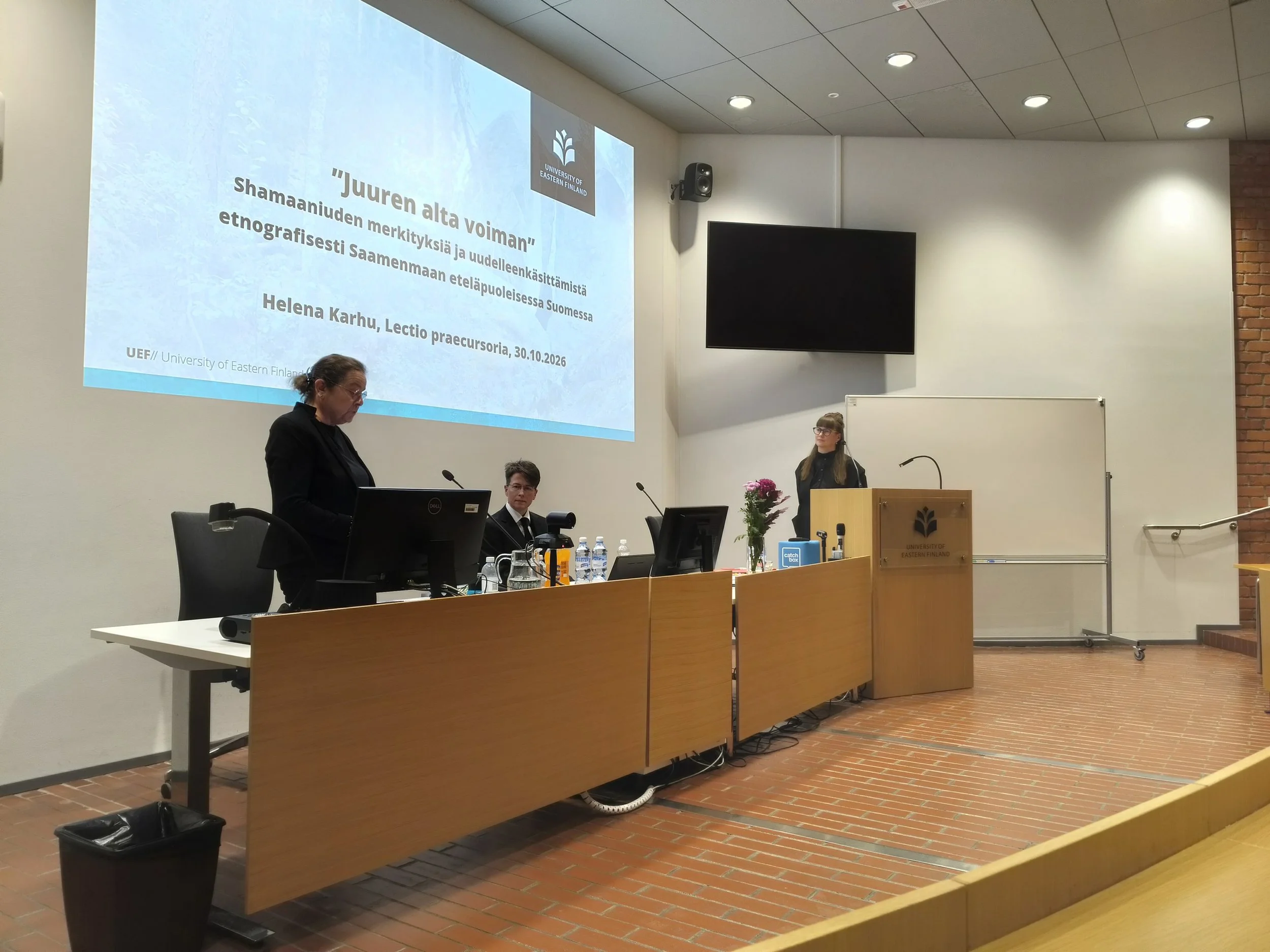
In the photo, from left to right: the opponent, PhD, Docent Jaana Kouri; in the center, the custos, Professor Teo Kurki; and on the left, Helena Karhu. Photograph: Elina Hytönen-Ng
While reflecting on the dimension that connects all three of my research articles, "deep time"—a concept I learned from archaeologists Antti Lahelma and Vesa-Pekka Herva (2020)—emerged as a key perspective. Deep temporality refers to the recognition of continuities spanning millennia within living culture and nature (see Herva and Lahelma 2020). Herva and Lahelma (2020, 15) write about how northern cultures maintain deep-temporal and ancient roots; according to them, modernity cannot erase archaic and non-rational modes of thought—modes whose significance in contemporary society often goes unrecognized or remains relegated to the margins. Their research, much like my own, seeks to understand how the practices of northern animistic and shamanistic lifeworlds are formed and renewed over millennia, through a reciprocal relationship between humans and the world (ibid.).
In the context of shamanism, this may refer, for example, to the connection with magic incantations dating back millennia and the significance of nature power places for those who possess such knowledge. Broadly speaking, it entails recognizing physical, psychological, and spiritual continuities that span millennia—reaching both into the deep past and far into the future. With future generations in mind, this also establishes an ethical and moral foundation for sustainable living on this planet.
My research suggests that the lifeworld of shamanism can be understood through a concept I have developed: relational enchantment. Ontologically, this perspective is rooted in the experience of connection—across time, within communities, across species, and through space—which is inherent to the experience of enchantment. Consequently, the deep-time connections of shamanism may manifest in the experience of an individual shamanic practitioner in a way that, to an outside observer, might initially appear detached from tradition. Yet, for someone living within this shamanic lifeworld, such a connection can develop into a deep-time web—much like a fungal mycelium—in which a mystical, primordial quality and the spirits of ancestors are ever-present.
Towards a Shamanic Anthropology?
In closing, I should also mention that, throughout my research, I have explored the possibility of a distinct field of study: shamanic anthropology. Shamanic anthropology would likely be a marginal field of study, emerging from a shift toward re-enchanting, decolonizing, and often autoethnographically examining one’s own culture. Its foundation would lie in an animistic ontology and shamanic methods of acquiring knowledge. The research would encompass ritual and ceremonial dimensions aimed at ensuring reciprocity with the natural world. Shamanic anthropology would function as a nature-centered science and a form of research-creation—a space where we could explore not only what shamanism is, but also what it can transformatively bring about.
Thank you.
Note: The lecture contains a few direct excerpts from my doctoral dissertation (Karhu 2026).
Bibliography:
Billet, Matthew I, Adam Baimel, Mark Schaller, and Ara Norenzayan 2025. “Ecospirituality.” Current Directions in Psychological Science: A Journal of the American Psychological Society 34 (2): 97–104. https://doi.org/10.1177/09637214241304326.
Heikkurinen, Pasi 2024. Degrowth. An Experience of Being Finite. Mayfly Books.
Herva, Vesa-Pekka, and Antti Lahelma 2020. Northern Archaeology and Cosmology: a Relational View. Abingdon, Oxon: Taylor & Francis.
Karhu, Helena 2026. ”Juuren alta voiman” Shamaaniuden merkityksiä ja uudelleenkäsittämistä Saamenmaan eteläpuoleisessa Suomessa [“Power from Beneath the Root”]: Ethnographic Perspectives on the Meanings and Reconceptualization of Shamanism in Finland, South of Sápmi. University of Eastern Finland.
Kouri, Jaana and Elina Hytönen-Ng 2022. “The change in researcher’s position in the study of shamanism.” Approaching Religion 12 (1): 117–131.
Pentikäinen, Juha 1996. Introduction. In Shamanism and Northern Ecology, edited by Juha Pentikäinen. Berlin: Mouton de Gruyter.
Sawyer, Richard D. and Joe Norris 2013. Duoethnography. New York: Oxford University Press.
Setälä, Johannes 2018. JUM. Salakirjat.
Siikala, Anna-Leena 2017 (1994). Suomalainen šamanismi. Mielikuvien historiaa. Helsinki: Finnish Literature Society.
Svanberg, Jan 2003. Schamantropologi i gränslandet mellan forskning och praktik: en studie av förhållandet mellan schamanis